
The nine Centers in Human Design are the foundation of your chart. They show how your energy thinks, feels, expresses, and moves through daily life. Some of your Centers are steady and reliable. Others are sensitive, flexible, and deeply intuitive. All of them shape the way you show up in the world.
Understanding your Centers can help you make sense of your patterns. It explains why you may feel grounded in one area and more changeable in another.
And here’s the most important thing to know as you begin:
Defined Centers are not better than Undefined Centers. Undefined Centers are not better than Defined Centers. Each one offers its own gifts, lessons, and strengths.
As you learn about your Centers, you’ll start to see yourself with fresh clarity and move through life with more ease. Let’s begin with the basics.
What Defined vs.Undefined really means
Every Center in your chart is either Defined, Undefined, or Open. Undefined Centers are your receptors, while Defined Centers are your transmitters.
Neither is better. They simply work differently.
Defined Centers
A Defined Center is colored in on your chart. This is where your energy is consistent, steady, and reliable. You broadcast this energy out into the world. It is part of what makes you you.
People with Defined Centers usually feel more self-contained in these areas. You influence others here more than you receive from them.
Undefined Centers
An Undefined Center is white but still has at least one active gate. These Centers are receptive, sensitive, and flexible. You take in energy from the world around you and often amplify what you feel.
Undefined Centers are where you learn the most about yourself. Over time, they become areas of deep wisdom, but they can feel inconsistent if you try to make them operate like Defined Centers.
Open Centers
An Open Center is another special category worth mentioning. It is a special type of Undefined Center. All Open Centers are Undefined but not all Undefined Centers are Open.
An Open Center is white and has no activated gates. This creates even more sensitivity.
Someone with an Open Center has no built-in filter here. They feel everything. They can also become profoundly wise because of this openness.
When you have an Open Center, you are entirely receptive in that area. Everything comes in. This can feel overwhelming until you learn how openness operates in your daily life. Over time, it becomes a place of extraordinary wisdom because you have access to the full spectrum of experiences linked to that Center.
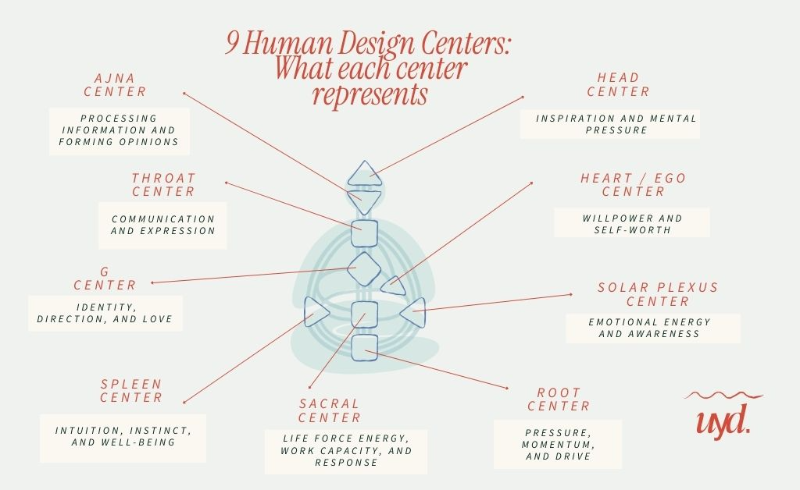
The nine Centers in Human Design explained one by one
Each of the nine Centers has its own purpose. Some give you steady, reliable energy. Others help you grow through openness, sensitivity, and experience. Neither Defined nor Undefined is better. You need both to create a balanced, human life.
The head Center
Role: Inspiration and mental pressure.
The Head Center is where ideas, questions, doubt, and inspiration move through you.
Defined:
You have a consistent way of receiving inspiration. You think in a steady pattern and feel mental pressure in a predictable way.
Undefined or Open:
You take in other people’s ideas. You may feel pressure to answer questions that are not yours. Your inspiration rises and falls based on who you are with.
The ajna Center
Role: Processing information and forming opinions.
The ajna Center helps you turn ideas into understanding.
Defined:
You process information in a consistent way. You tend to hold steady opinions or beliefs.
Undefined or Open:
Your mind is flexible. You see many sides of an issue. Your perspective shifts depending on the moment and the people around you.
The throat center
Role: Communication and expression.
The Throat is where energy becomes words, actions, and expression.
Defined:
You have a reliable voice. You express yourself in a consistent way. People often recognize your tone, presence, or communication style.
Undefined or Open:
Your voice adapts to your environment. You express yourself differently with different people. You may feel pressure to speak or not know what to say.
The G center
Role: Identity, direction, and love.
The G Center guides your sense of self and the direction your life naturally moves.
Defined:
You have a steady sense of who you are. Even if life evolves, there is a grounded core inside you that stays the same.
Undefined or Open:
Your identity is fluid. You shift based on the people and spaces around you. You learn who you are through experience, not certainty.
The heart center
Role: Willpower, value, and commitment.
The Heart Center shows how you use willpower and how you feel your worth.
Defined:
You have consistent willpower. When you commit to something, you follow through. You know what you want.
Undefined or Open:
Your motivation changes. You may feel pressure to prove yourself or say yes when you do not have the energy. Your value is not tied to willpower.
The sacral center
Role: Life force energy, work capacity, and response.
The Sacral is the motor that fuels creativity, work, sexuality, and vitality.
Defined:
You have consistent access to energy when you are doing what you love. You are built for sustained work, but only when it feels right for you.
Undefined or Open:
You are not meant to work endlessly. Your energy rises and falls. Rest is essential. You gain energy from the people around you but release it when you are alone.
The solar plexus center
Role: Emotional energy and awareness.
The Solar Plexus governs emotional waves and sensitivity.
Defined:
You feel emotions in waves. Your clarity comes with time. You teach others emotional awareness.
Undefined or Open:
You amplify others’ emotions. You feel what others feel, often intensely. You are here to grow wise about emotional boundaries.
The spleen center
Role: Intuition, instinct, and well-being.
The Spleen helps you sense what feels safe, healthy, or aligned.
Defined:
You have a steady sense of intuition. Your instinctive hits are reliable and come in the moment.
Undefined or Open:
You are sensitive to fears, wellness challenges, and other people’s instincts. You may hold on to things longer than you should because they once felt safe.
The root center
Role: Pressure, momentum, and drive.
The Root is your relationship to stress, timelines, and getting things done.
Defined:
You have a steady internal pressure. You handle stress well. You can move quickly without feeling overwhelmed.
Undefined:
You take in and amplify pressure from others. You may rush, feel anxious, or push yourself too hard.
How Defined and Undefined Centers shape your relationships
Your Centers do not operate in isolation. They interact with the people around you every day. When you understand how Defined and Undefined Centers work together, your relationships make a lot more sense.
- Defined Centers broadcast energy.
- Undefined and Open Centers receive and amplify energy.
When you put two people together, their Centers create an energetic mix. Neither side is right or wrong. They are simply different. And when you understand those differences, your relationships become gentler, kinder, and easier to navigate.
How this shows up in partnerships
- If you have a Defined Solar Plexus and your partner is Undefined, they may feel your emotions more intensely than you do.
- If your partner has a Defined Sacral and you are Undefined, you may feel energized around them and tired once you are alone.
- If one of you has a Defined G Center and the other has an Open G Center, the Open person may naturally attune to the identity and direction of the Defined person.
These dynamics are normal. You are not doing anything wrong. This is simply how your energy speaks to each other.
How this shows up in friendships
- A friend with a Defined Throat Center may naturally lead conversations.
- A friend with an Undefined Root may feel rushed when spending time with someone who has a Defined Root.
- In a group setting, someone with an Undefined Head may feel mentally overstimulated.
Understanding these patterns helps you take things less personally. It also shows you where you may need space, quiet, or grounding after social interactions.
How this shows up in families
Family systems amplify everything. You live close together. You share routines. You share an emotional tone. And understanding your child’s Human Design can help you with your parenting.
- A child with an Undefined Solar Plexus may absorb a parent’s emotional wave.
- A parent with a Defined Ego may unintentionally pressure a child with an Open Ego to prove themselves.
- A sibling with a Defined Ajna may feel certain while a sibling with an Undefined Ajna feels pulled in multiple directions.
Seeing these differences can shift how you support each other. It also helps you zoom out and remember that everyone is functioning through their own design.
Final thoughts
Understanding the Human Design nine Centers is one of the most empowering steps you can take in your Human Design journey. It shows you where your energy is steady and where it is sensitive. It helps you understand your patterns instead of fighting them. And it shows you that nothing about you is accidental.
If you want a deeper, more personal look at your design, you can order a custom Human Design storybook. It explains your Centers, your strengths, and your energetic patterns in a way that feels clear, grounded, and uniquely you. It is a beautiful next step if you are ready to understand who you are on a deeper level.